

Jennifer's Market Minute: July 2026

Is San Antonio’s Housing Market Really Balanced? It Depends on Your Price Point.
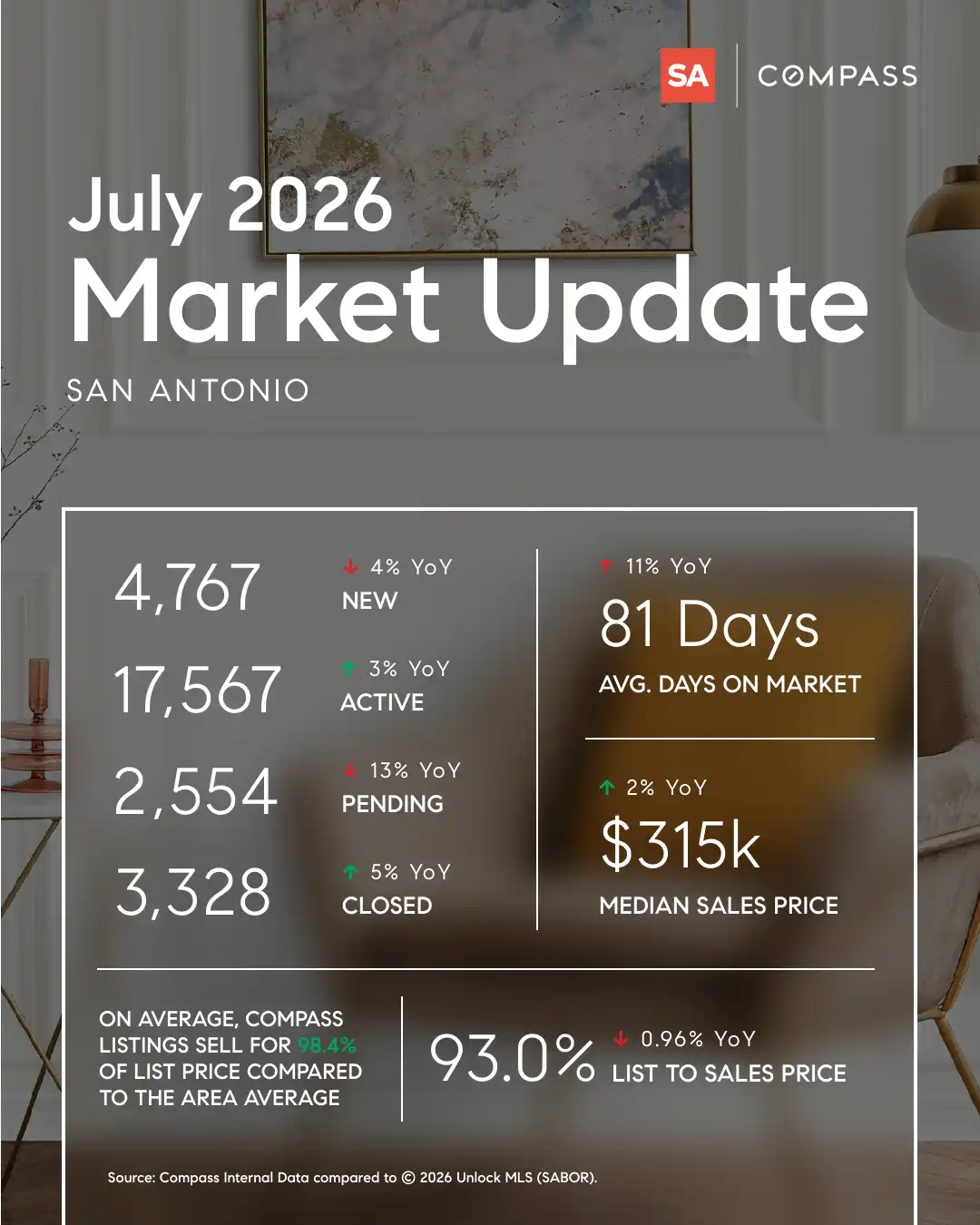
On paper, the San Antonio housing market looks pretty balanced. July ended with just over six months of housing inventory, while 3,328 single-family homes sold, 5% more than the same month last year. The median sales price was $315,000, up 2% year over year.
But there’s an important piece of the story those market-wide numbers don’t show: your experience as a buyer or seller can look very different depending on your price point.
In July, single-family homes priced between $200,000 and $249,999 had 5.4 months of inventory. Between $300,000 and $399,999, inventory increased to 6.2 months. Move into the $500,000–$749,999 range and it climbed to 7.3 months. At $1 million and above, there were 14.1 months of inventory.
So, is San Antonio’s housing market balanced? Overall, yes. But that doesn’t necessarily mean your market is.
The Numbers
Here are a few key takeaways from July’s San Antonio single-family market:
- Closed Sales: 3,328 homes (+5% year over year)
- Active Listings: 17,567 homes (+3%)
- New Listings: 4,767 homes (-4%)
- Pending Sales: 2,554 homes (-13%)
- Median Sales Price: $315,000 (+2%)
- Average Days on Market: 81 days (+11%)
- Housing Inventory: approximately 6.2 months
- Average Sale-to-Original-List Price: 93%
July’s numbers show a market where homes are still selling and prices have remained relatively stable, but buyers have choices. Pending sales were down 13% from last July, homes took longer to sell, and the average home ultimately sold for 93% of its original asking price.
The Market Changes by Price Point
This is where July’s data gets particularly interesting.
| Single-Family Price Range | Months of Inventory | Avg. Days on Market | % of Original List Price |
|---|---|---|---|
| $150K–$199K | 5.0 | 86 | 89.2% |
| $200K–$249K | 5.4 | 73 | 92.2% |
| $250K–$299K | 5.8 | 80 | 93.9% |
| $300K–$399K | 6.2 | 77 | 94.7% |
| $400K–$499K | 6.4 | 91 | 94.9% |
| $500K–$749K | 7.3 | 86 | 94.4% |
| $750K–$999K | 8.6 | 72 | 94.9% |
| $1M+ | 14.1 | 84 | 91.3% |
The pattern is pretty clear: inventory generally increases as you move up in price.
A homeowner selling around $225,000 is competing in a market with roughly five months of inventory, while someone selling a million-dollar property is operating in a segment with more than a year’s worth of inventory based on the current sales pace.
That’s why broad statements like “San Antonio is a balanced market” only go so far. Price point matters, and so do neighborhood, property condition, nearby competition and new construction.
What This Means for Buyers
If you’re buying a home in San Antonio, more inventory generally means more choice – and potentially more negotiating power.
That opportunity becomes increasingly noticeable in some of the higher price ranges, where there are more homes available relative to the current pace of sales. Buyers may have more time to compare properties and potentially negotiate on price, repairs, closing costs or other terms.
But that doesn’t mean every seller is desperate to negotiate or every home is overpriced. A well-priced home in a desirable location can still attract attention quickly, even in a market with higher overall inventory.
The better approach is to look at the competition around the specific home you’re considering rather than assuming citywide statistics tell you how aggressively you should negotiate.
If you’re trying to determine whether a property is actually a good value, I go deeper into that in How to Spot a Great Deal in a High-Rate Market.
What This Means for Sellers
There are still buyers in the market. More homes closed this July than last July, and the median sales price was slightly higher year over year.
But buyers also have options.
The more inventory you’re competing against in your particular segment, the more important it becomes to understand that competition before putting your home on the market. Condition, presentation and your initial list price can make a meaningful difference when buyers have several similar properties to choose from.
It’s also why I don’t believe a citywide median price or months-of-inventory figure is enough to determine what your home is worth. Your neighborhood, price point and direct competition matter far more.
In today’s market, strategic pricing remains incredibly important. I cover that in more detail in The Art of Pricing Your Home Right (Even When You’re Emotionally Attached).
What I’m Seeing Locally
The increased negotiating room we’re seeing in the data is showing up in my day-to-day business, too.
Seller concessions have become very common. Offers coming in on my listings have included requests for seller-paid closing costs and home warranties, while buyers I’m representing have been asking for concessions that can be used toward interest-rate buydowns. In today’s rate environment, negotiating the terms of the deal can sometimes be just as important as negotiating the purchase price.
Buyers are also looking beyond cosmetic condition. They want to know the age of major systems like the roof, HVAC and water heater before deciding how comfortable they are with a home – and what they’re willing to offer for it. When buyers have plenty of homes to choose from, those details matter.
I’m also noticing something with homes that have been sitting on the market for an extended period of time, particularly vacant properties. After 100+ days, little things can start to add up: cobwebs around the entry, wasp nests near the porch, dead bugs inside, landscaping flyers piling up at the door or patios that need a quick sweep.
None of those things necessarily indicate there’s anything wrong with the house, but they can change a buyer’s first impression before they’ve even made it through the front door.
For sellers, it’s a good reminder that showing-ready isn’t a one-time task when the listing goes live. In a market where buyers have plenty of choices, a home needs to continue looking cared for throughout its time on the market. I’m also seeing proactive listing agents work hard to follow up after showings, gather useful feedback and keep their listings in front of prospective buyers and their agents.
For buyers, those longer-market-time properties shouldn’t automatically be dismissed. Sometimes a home has been sitting because it started too high, there’s significant competition nearby, or it simply hasn’t connected with the right buyer yet. A property with a little dust on the porch may still be a great house – and extended market time can sometimes create an opportunity to negotiate terms that weren’t available when the home first hit the market.
My Take
Calling San Antonio a balanced housing market isn’t wrong. It’s just incomplete.
The overall numbers suggest neither buyers nor sellers have an overwhelming advantage. But once we look beneath those averages, we see meaningful differences based on price point – and the picture can change even further when we narrow the data to a particular neighborhood, property type and home.
There’s another layer the statistics don’t completely capture, either. A recorded sales price tells us what a home ultimately sold for, but it doesn’t necessarily tell us about seller concessions or other negotiated terms that helped get the transaction to the closing table.
That’s why I wouldn’t make a buying or selling decision based solely on a headline declaring San Antonio a “buyer’s market,” “seller’s market” or even a “balanced market.”
The more useful question is:
What’s happening in the part of the San Antonio market that actually applies to you?
If you’re wondering what today’s market conditions mean for your home’s value, your buying power or your plans for the next year, let’s have a conversation. Every home, neighborhood and situation is different, and I’d be happy to help you look at the numbers that actually matter to your decision.

Jennifer Anderson is a San Antonio Realtor providing local market insights with a focus on far west side neighborhoods and the needs of military and relocating families. She helps clients interpret market data in practical terms so they can make confident buying and selling decisions.
Social Cookies
Social Cookies are used to enable you to share pages and content you find interesting throughout the website through third-party social networking or other websites (including, potentially for advertising purposes related to social networking).